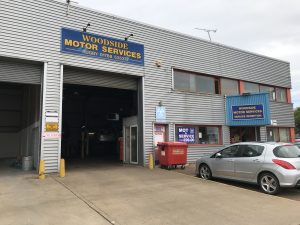
A great day at work as I visitied Dev and the team at Woodside Motor Services in Rugby. Every member of staff from reception to Technicians were so friendly and helpful which explains why they have a 5 out of 5 star rating on ‘Book my Garage’
Keep up the excellent work team and see you soon.
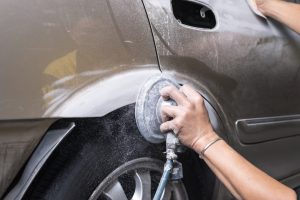
Perrys Motor Sales Ltd (PMS) and S & Ash Ltd (previously known as Sound Advice Safety and Health Ltd.), have both been sentenced for safety breaches, after a worker developed Hand Arm Vibration Syndrome (HAVS).
An employee working as a small to medium area repair technology (SMART) repairer at the PMS site in Doncaster, who regularly used handheld power tools to undertake small scale vehicle body work repairs, when he was diagnosed with HAVS in 2013, Sheffield Crown Court was told.
The HSE’s investigation discovered that that PMS had failed to adequately assess and control the foreseeable risk to SMART repairers. Following the diagnosis, PMS took no action to protect the employee from further damage to his health and his condition was not reported to the authorities in line with legal requirements.
At the time, the firm now going by the name of S & Ash Ltd was engaged by PMS to provide HAVS health surveillance for employees. The investigation also found that following the health surveillance, S & Ash Ltd failed to provide suitable and accurate advice to the employer (PMS) or to inform the employee of the results of his health surveillance, even when specifically requested to do so by him.
Perrys Motor Sales Ltd of Pavilion Drive, Northampton Business Park, Brackmills Northampton pleaded guilty to breaching Section 2 (1) of the Health & Safety at Work etc Act 1974 and Regulation 8 of The Reporting of Injuries, Diseases and Dangerous Occurrences Regulations (RIDDOR) 2013. The company has been fined £140,000 and ordered to pay £7,658.67 in costs.
S & Ash Ltd of Charles House, Albert Street, Eccles, Manchester pleaded guilty to breaching Section 3 (1) of the Health & Safety at Work etc Act 1974. The company has been fined £4,000 and was ordered to pay £8,716.17 in costs.
After the hearing, HSE Inspector Heather Cunnington commented: “Vibration can cause long-term painful damage to hands and fingers.
“The motor vehicle repair trade must understand the importance of suitable risk assessments and having a robust occupational health and safety management system. Employers should ensure that the results of health surveillance are acted upon and employees are protected from the risks from HAV when working with handheld power tools.
“Occupational health providers are in a unique position in safeguarding the health of employees and must provide accurate reports to employers following HAV health surveillance. Employers must act on these reports.”
For further information on avoiding Body Repair injuries then contact us today
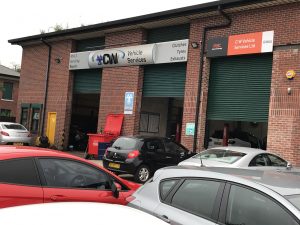
We are delighted to be working alongside the incredibly busy & popular CW Vehicle Services. It not an understatement that Steve the owner is probably the friendliest person in the motor trade and its great that more and more smaller garages like his are now embracing health and safety.

It’s apparent that most firms are having to make redundancies and in many cases the position for the chop is the person responsible Health & Safety.
If this is your scenario, and as a Director you are now feeling vulnerable, then don’t panic as we have a solution to help.
We are offering unlimited telephone support to all companies that operate in the Automotive sector, until the end of August 2020 at no cost.
Having a professional to talk to and gain advice from will make you feel less anxious & exposed.
What is the catch I hear you ask? There is no catch, we would simply like to help on the proviso of potentially gaining your business in the future.
Its as simple as picking up the phone and giving us a call and in some cases, we could attend site to carry out a mini Health & Safety Audit.
For further information and peace of mind then contact us today
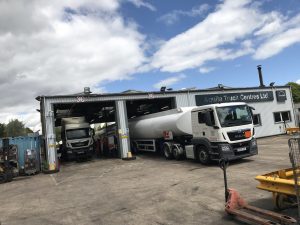
SCS are no stranger to the Oil and Gas industry. Currently we are employed by three large motor groups at three different Oil Refineries to ensure the Vehicle Manufacturing Units (VMU) run like clock work with full Health & Safety Compliance and zero accidents. We are delighted to make it a fourth at with the kind ivitation to be working with Aquila Trucks Centres and this site at Tamorth on the BP Site.
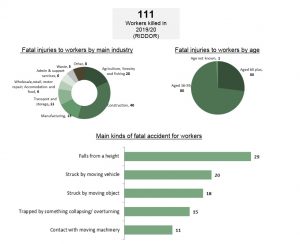
Yet again the second highest cause of workplace fatality was being struck by a moving vehicle.
Other Key figures for Great Britain (2018/19)
1.4 million working people suffering from a work-related illness
2,446 mesothelioma deaths due to past asbestos exposures (2018)
111 workers killed at work (2019/20)
581,000 working people sustaining an injury at work according to the Labour Force Survey
69,208 injuries to employees reported under RIDDOR
28.2 million working days lost due to work-related illness and workplace injury
£15 billion estimated cost of injuries and ill health from current working conditions (2017/18)
For further information on avoiding serious incidents then contact us today
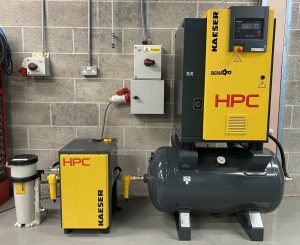
If pressure systems have not been used for an extended period of time due to the coronavirus (COVID-19) outbreak they may become unsafe.
Pressure systems can be standalone or part of individual machines, processes and site (ancillary) services and include air compressors and receivers & hydraulic cylinders for vehicle lifts.
Examination period
If pressure systems forming part of machinery have exceeded their examination period, you should get the agreement of a competent advisor before restarting the machine.
Safety issues
There are safety issues from contamination of fluids and/or gases generated that can cause unexpected behaviour of the pressure elements of machinery leading to unintended outcomes, such as:
water ingress – condensate forming in steam vessels due to external temperature changes, causing violent energy exchange (possible explosion)
air ingress – due to seal degradation on hydraulic cylinders, etc permitting air to be drawn leading to creep or unintended movement of mechanical parts
internal structural corrosion – particularly from cooling of steam systems, forming pooling of condensate in the base of vessels
bypass of safety devices – is possible following incorrect re-assembly of pipework after cleaning (in particular, explosion can occur when solvents are involved)
Restarting a pressure system safely
We recommend that you should regard the start-up of all pressure systems forming part of machinery as a functional pressure test.
Starting up any pressure system from cold can significantly affect the mechanical behaviour of vessels, pipework and moving parts. For example:
pressure relief valves contain mechanical spring mechanisms. There is potential that these may have seized or fatigued as a result of a constant level of compression over a period of time. We recommended that you closely inspect and test safety devices like these. If you have any concerns, replace them. (ie a new one that has relevant certificates)
hydraulic fluids will be more viscous when cold. Often, parts appear to move more sluggishly and there can be a time delay in response to operating controls
where hydraulic systems have been left switched on, continuous recirculation can result in significant increase in temperature of the fluid. Unintended release or hose failure would result in hot oil being sprayed out.
For further information on equipment inspections then contact us today
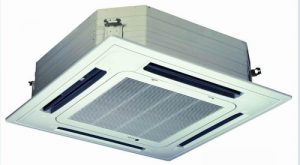
Air conditioning
The risk of air conditioning spreading coronavirus (COVID-19) in the workplace is extremely low.
You can continue using most types of air conditioning system as normal. But, if you use a centralised ventilations system that removes and circulates air to different rooms it is recommended that you turn off recirculation and use a fresh air supply.
You do not need to adjust air conditioning systems that mix some of the extracted air with fresh air and return it to the room as this increases the fresh air ventilation rate. Also, you do not need to adjust systems in individual rooms or portable units as these operate on 100% recirculation.
If you’re unsure, ask the advice of your heating ventilation and air conditioning (HVAC) engineer or adviser.
General ventilation
Employers must, by law, ensure an adequate supply of fresh air in the workplace and this has not changed.
Good ventilation can help reduce the risk of spreading coronavirus, so focus on improving general ventilation, preferably through fresh air or mechanical systems.
Where possible, consider ways to increase the supply of fresh air, for example, by opening windows and doors (unless fire doors).
Also consider if you can improve the circulation of outside air and prevent pockets of stagnant air in occupied spaces. You can do this by using ceiling fans, desk fans or opening windows, for example.
The risk of transmission through the use of ceiling and desk fans is extremely low.
For further information about protecting employees then contact us today
The coronavirus outbreak has not changed employers’ duty to make sure people are not exposed to hazardous substances as part of their work.
Employers must protect workers from injury or harm to health which could happen as a result of work-related activity. This includes taking reasonable steps to protect your workers and others from coronavirus (COVID-19).
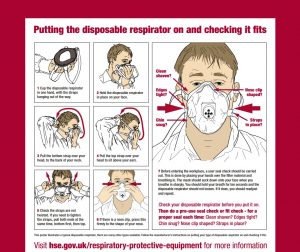
During the outbreak, HSE has worked with others to develop guidance about current issues with PPE including the new ‘Using Disposable Respirators’ poster.
When Using Disposable Respirators the following Pre-use checks should be carried out
You should be clean-shaven around the face seal to achieve an effective fit when using disposable respirators. Beards and stubble will stop the disposable respirator sealing to your face and protecting you properly
Make sure it is the right disposable respirator for your work and for you – have you passed a face fit test in this disposable respirator?
Make sure the disposable respirator is clean and undamaged before you use it
Follow the manufacturer’s instructions for checking the disposable respirator and putting it on
Check the fit every time you put on the disposable respirator to ensure there are no leaks
For the latest from The HSE on the use of PPE and face coverings during the outbreak CLICK HERE
For further information about protecting employees then contact us today
Introduction
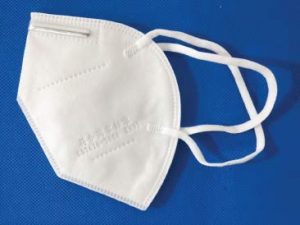
A substantial number of face masks, claiming to be of KN95 standards, provide an inadequate level of protection and are likely to be poor quality products accompanied by fake or fraudulent paperwork. These face masks may also be known as filtering facepiece respirators.
KN95 is a performance rating under the Chinese standard GB2626:2006, the requirements of which are broadly the same as the European standard BSEN149:2001+A1:2009 for FFP2 facemasks. However, there is no independent certification or assurance of their quality and products manufactured to KN95 rating are declared as compliant by the manufacturer.
Personal protective equipment (PPE) cannot be sold or supplied as PPE unless it is CE marked. The only exception is for PPE that is organised by the UK Government for use by NHS or other healthcare workers where assessments have been undertaken by HSE as the Market Surveillance Authority.
Action required
KN95 must not be used as PPE at work as their effectiveness cannot be assured.
Masks that are not CE marked and cannot be shown to be compliant must be removed from supply immediately. If these masks have not been through the necessary safety assessments, their effectiveness in controlling risks to health cannot be assured for anyone buying or using them. They are unlikely to provide the protection expected or required.
If any are CE marked, suppliers must be able to demonstrate how they know the documentation and CE marking is genuine, supported by Notified Body documentation showing compliance with the essential health and safety requirements as required by the Personal Protective Equipment Regulations (EU) 2016/425.
Relevant legal documents
Personal Protective Equipment Regulations (EU) 2016/425
Personal Protective Equipment (Enforcement) Regulations 2018
Further information
Online Training. Providing effective eLearning
Find out more about our training, including the extensive catalogue from our partner iHasco